Scale versus Specificity
Why the next billion-dollar companies might look small from the outside.

We recognized Martin Gross of Gross-Wen Technologies as the 2026 Agricultural Entrepreneur of Year this week. So, algae has been on my mind. Stick with me here!
One of the more interesting things about algae is that most people think of it as a problem. They think of pond scum, toxic blooms, green lakes in August, and the Gulf of Mexico/America dead zone
Algae, to most people, signals imbalance.
And yet algae may also be one of the better metaphors for where the economy is heading.
Tiny organisms. Hyper-specific. Adaptive. Distributed. Often overlooked.
Yet capable of transforming entire systems.
The industrial economy taught us that scale wins.
Bigger factories. Bigger firms. Bigger supply chains. Bigger brands.
But the emerging economy increasingly suggests something different: Specificity wins.
Or perhaps more accurately: Specificity is becoming scalable.
The next billion-dollar companies may not look large from the outside. They may look niche. Technical. Regional. Weird even. They may solve problems most people barely notice.
But they may become indispensable within the systems they inhabit.
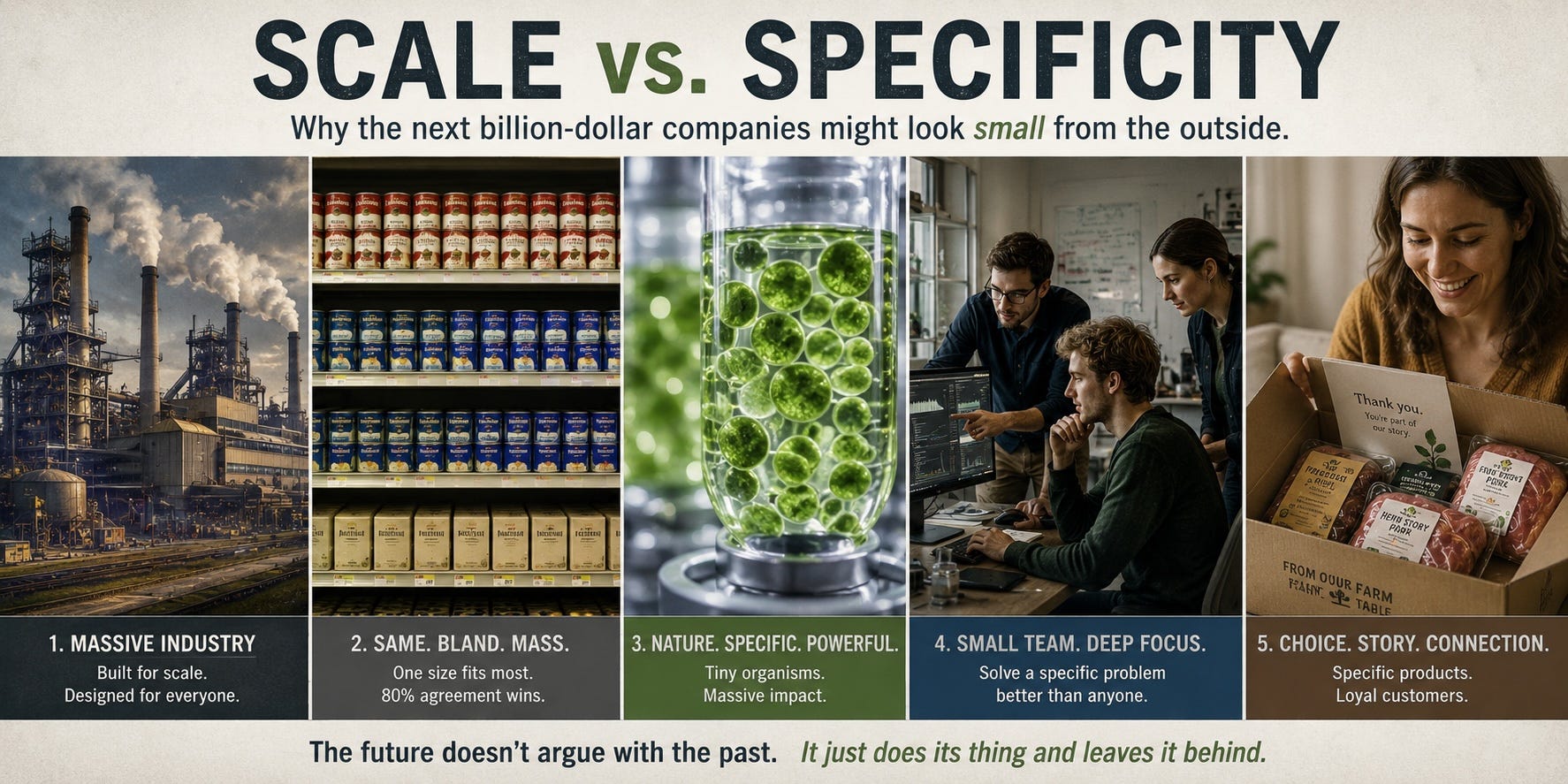
From Scale to Specificity
In several recent essays, I’ve explored related themes: the rise of builders, the disaggregation of the economy, the end of mass taste, and the remaking of supply chains.
All point toward a similar conclusion: The industrial age optimized for sameness.
The emerging age increasingly rewards differentiation.
For most of the 20th century, scale solved problems.
Large organizations existed because they could coordinate production, distribution, and information more efficiently than fragmented systems could. Mass markets rewarded standardization. National media reinforced common tastes. Supply chains favored throughput over specificity.
The result was a world where large companies looked… large. Steel mills. Automobile plants. Grain processing plants. Corporate headquarters. Large. Large. Large.
Success was visible.
But what if scale itself is changing shape?
Mainframes, PCs, and the Quiet Arrival of the Future
I’ve seen this dynamic before.
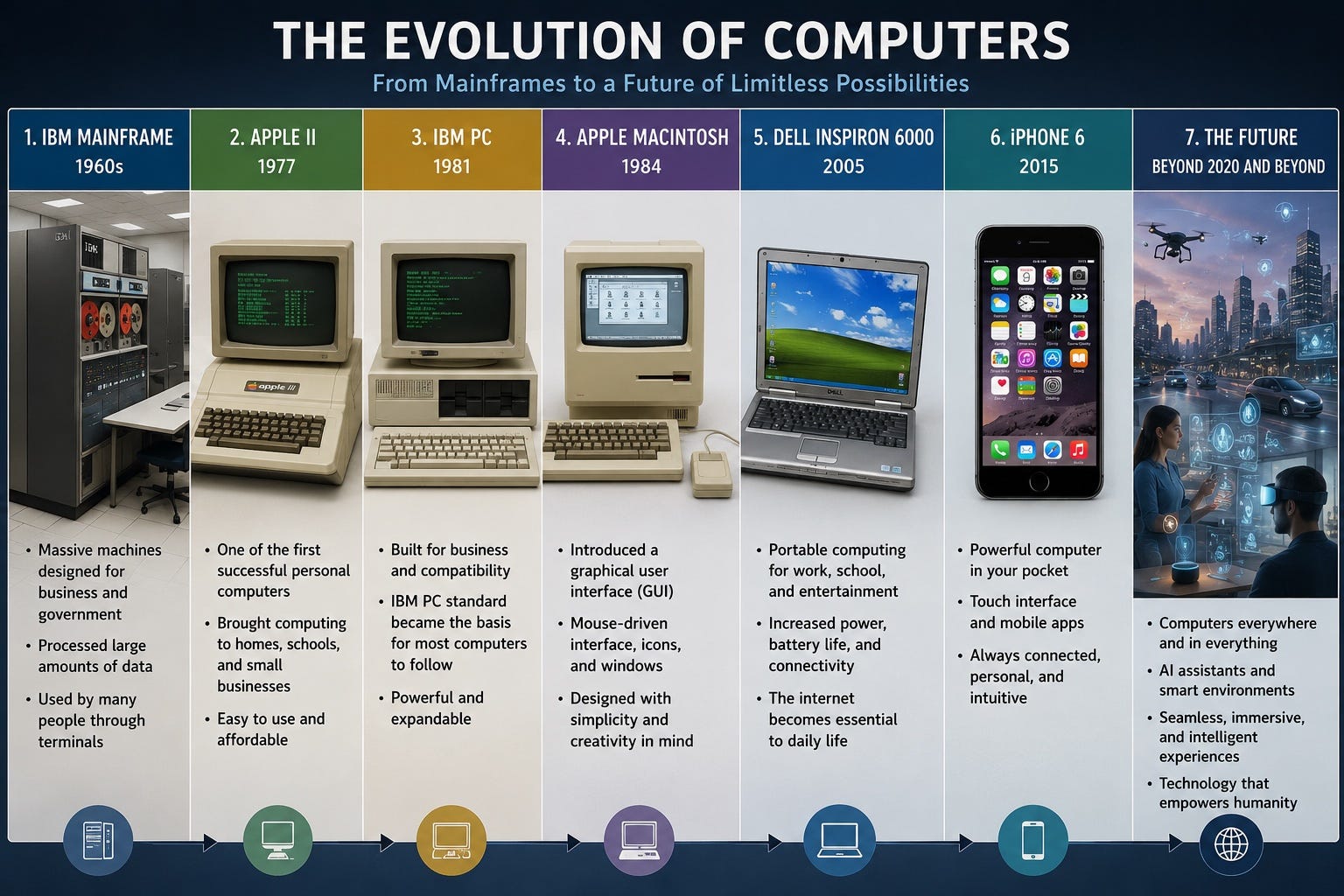
From 1981 to 1985 in high school, I learned my first bits of software coding on an Apple II. At the time, computing still largely belonged to institutions. Large organizations had mainframes. Computing power was centralized. Access was controlled. My tiny high school (less than 20 per class), couldn’t afford a mainframe or mini-computer. But it could a short row of Apple II’s.
In undergrad at the University of Nebraska from 1985 to 1989, IBM PCs started appearing more broadly. The machines were primitive by modern standards, but something was changing. I found them at the East Campus Library and at a fraternity. A buddy and I thought we were probably cheating by using a VisiCalc, an early spreadsheet, for some of our assignments. But it made short work of the assignments.
Then I arrived at Iowa State University in 1989 for graduate school.
At the time there was still a debate of sorts between IT-supported centralized university computing systems and graduate students like me increasingly using PCs. I recall logging into what I think was an IBM System/360 using WYLBUR on a green screen and struggling to get much done. But we were also beginning to use PC-based spreadsheets and statistics software that was faster, cheaper, and more flexible for our modeling work than the institutional systems many departments relied on.
You could see the future. It was smaller computers. More distributed computers. More accessible. More used.
The future never argues much with the past.
It just quietly does its thing and leaves the old system behind.
The PC didn’t immediately destroy mainframes and mini computers. Large systems remained important. But the center of gravity shifted.
Computing disaggregated.
What had once required massive centralized infrastructure became distributed.
And once that happened, entirely new industries emerged.
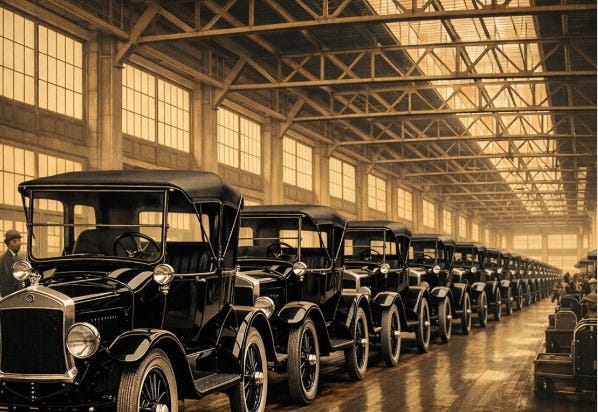
The Industrial Economy Rewarded Scale
The industrial economy naturally favored aggregation.
Large firms won because they could coordinate labor, finance infrastructure, build distribution systems, manage logistics, and market at national and international scale.
This produced some of the defining firms of the 20th century such as Ford early, IBM mid, and Walmart late.
Scale reduced costs. Standardization increased efficiency.
The system worked remarkably well.
But it also produced something else: Sameness.
Mass products. Mass culture. Mass markets.
The goal was broad agreement.
Win 80% of the market.
Sell one thing to everyone.
Craft Beer Applied to… Everything
One of the earliest signs that this model was beginning to weaken came through beer.
As I wrote in The End of Mass Taste, the craft beer movement did not need to dominate beer consumption in order to transform the industry.
It simply needed to prove that consumers no longer wanted the exact same thing.
The craft brewers didn’t out-scale Budweiser.
They out-specified it.
Suddenly beer became IPA, stout, hazy IPA, barrel-aged, farmhouse ale, or local seasonal release.
And once that happened, the logic spread.
Craft beer applied to coffee.
Craft beer applied to meat.
Craft beer applied to flour.
Which brings us to one of my favorite examples of specificity becoming premium value: wine.
The Wineification of Everything
You don’t have to be a wine snob to ask for something more specific than “red wine.”
They may ask for: grape variety, vineyard, winemaker, region, or year.
Not just Chardonnay. Balletto Sexton Hill Chardonnay.
Not just Zinfandel. Harvest Moon Pitts Home Ranch Zinfandel.
Not just Cabernet Franc. Col Solare Red Mountain Cabernet Franc.
Each of the above are highly recommended. And more serious wine people than me will debate which years are best.
The product becomes layered with specificity.
Origin matters. Process matters. Story matters. Identity matters.
What if more of the economy begins to behave this way?
What if consumers increasingly move from generic to specific, mass to differentiated, and commodity to identity?
That shift favors entrepreneurs.
Algae and the New Shape of Scale
This brings us back to algae.
Most people see algae as an environmental problem. And sometimes it is. Nutrient runoff. Lake blooms. The Gulf dead zone.
But specificity changes perspective.
Because algae can also become a solution.
Gross-Wen Technologies is using algae to solve wastewater problems in municipal and industrial systems.
That sounds highly specific because it is.
Wastewater treatment is not exactly glamourous.
But the addressable problems are enormous in municipal water systems, industrial discharge, nutrient management, and environmental impact.
Gross-Wen does not look like a classic industrial giant.
It looks small. Technical. Biological.
But that may increasingly be what scalable companies look like.
Not massive standardized systems.
But highly specialized systems solving difficult edge problems.
Algae becomes the metaphor: Small organisms. Massive system effects.

Midland and Biological Infrastructure
A similar pattern appears in Midland Seafood’s shrimp production systems.
Their recirculating aquaculture systems rely on biological processes—including algae-related wastewater solutions—to create localized production loops.
Again, specificity matters.
This isn’t: “Build the world’s largest shrimp system.”
It’s: “Build a highly adaptive, highly efficient, distributed production environment.” Contract farms growing shrimp indoors across geography.
The scale emerges differently.
Not through brute size.
But through repeatable specialized systems.

Distynct and the Rise of Hyper-Specific Systems
The same pattern appears in livestock technology.
Distynct is building highly specific livestock sensing systems.
Not generic industrial hardware.
Not mass-market consumer electronics.
Specific systems for specific biological and agricultural environments.
This is increasingly where value creation happens. Solve a narrow problem. Develop a deep understanding of it. And build a highly adaptable solution
The industrial economy rewarded breadth.
The emerging economy increasingly rewards depth.
Roboflow and Invisible Scale
Stepping outside agtech somewhat, a good example of this new shape of scale is Roboflow.
Most people have never heard of it.
Yet it powers image-based AI systems used across industries. Over 1 million engineers deploy visual intelligence for video, images, and real-time streams with Roboflow.
It is infrastructure. Quiet infrastructure. Nearly invisible scale.
That may increasingly define billion-dollar companies.
Not giant public-facing brands.
But deeply embedded systems that become essential to specific workflows.
The Changing Geometry of Scale
This is the deeper shift.
Scale itself is changing geometry.
The old model looked centralized, vertically integrated, standardized, and physically massive.
The emerging model increasingly looks distributed, modular, software-enabled, biologically specific, and networked.
Scale no longer always means a giant workforce, giant factories, and a giant headquarters
Sometimes it means small teams, deep specialization, and systems replicated through networks.
Sam Altman (OpenAI) and more recently Dario Amodei (Anthropic), both said they expect the first one-person billion-dollar company to emerge very soon. The most cited current example is the GLP-1 telehealth story around Matthew Gallagher. Tether is arguably an even more important example economically, with the stablecoin company reportedly profiting more than $10 billion with around 100 employees.
What This Might Look Like in 20 Years
Twenty years from now, many industries may look more fragmented—but also more sophisticated.
More of agriculture and food may increasingly resemble wine.
Consumers may care about producer, region, genetics, feed, process, environmental profile, and story.
Infrastructure itself may become more biological, localized, and adaptive.
The future economy may not be dominated solely by giant monolithic systems.
It may increasingly consist of networks of highly specialized ones.
The industrial age taught us to associate scale with visibility.
Large buildings. Large factories. Large organizations.
But the next era may operate differently.
The companies that reshape the economy may not always look dominant from the outside.
They may look small.
Like craft brewers once did.
Like PC hobbyists once did.
Like algae.
And by the time the old system fully notices them, the future will already be well underway.
I’m thrilled to be a part of the Iowa Startup Collective, a group of writers exploring entrepreneurship. Please check out the Roundup of columns.
100% agreed here, Kevin!
A note I’ve recently shared team wide is how we have the chance to become the world’s largest farm, decentralized. Each location is a node and locally positioned and focused.