Remaking Supply Chains
Why the next economy won’t optimize the old system—it will rebuild it

For most of my career, supply chains weren’t something I had to think about. Sure, the nature of my work wasn’t supply chain focused. But still. You don’t have to work long in agriculture and technology to encounter complex supply chains that impact what you do.
And the assumption was that the supply chains usually worked.
Inputs showed up. Products moved. Prices fluctuated, but the system held. Global trade expanded, logistics improved, and efficiency became the dominant goal.
Systems were designed to deliver the lowest cost, at the highest scale, with the least friction.
And for a long time, it worked.
But over the past period of years, something’s changed.
Not just disruption.
Something deeper.
The combination of geopolitical shifts, changing consumer preferences, and new technologies is not just pressuring supply chains.
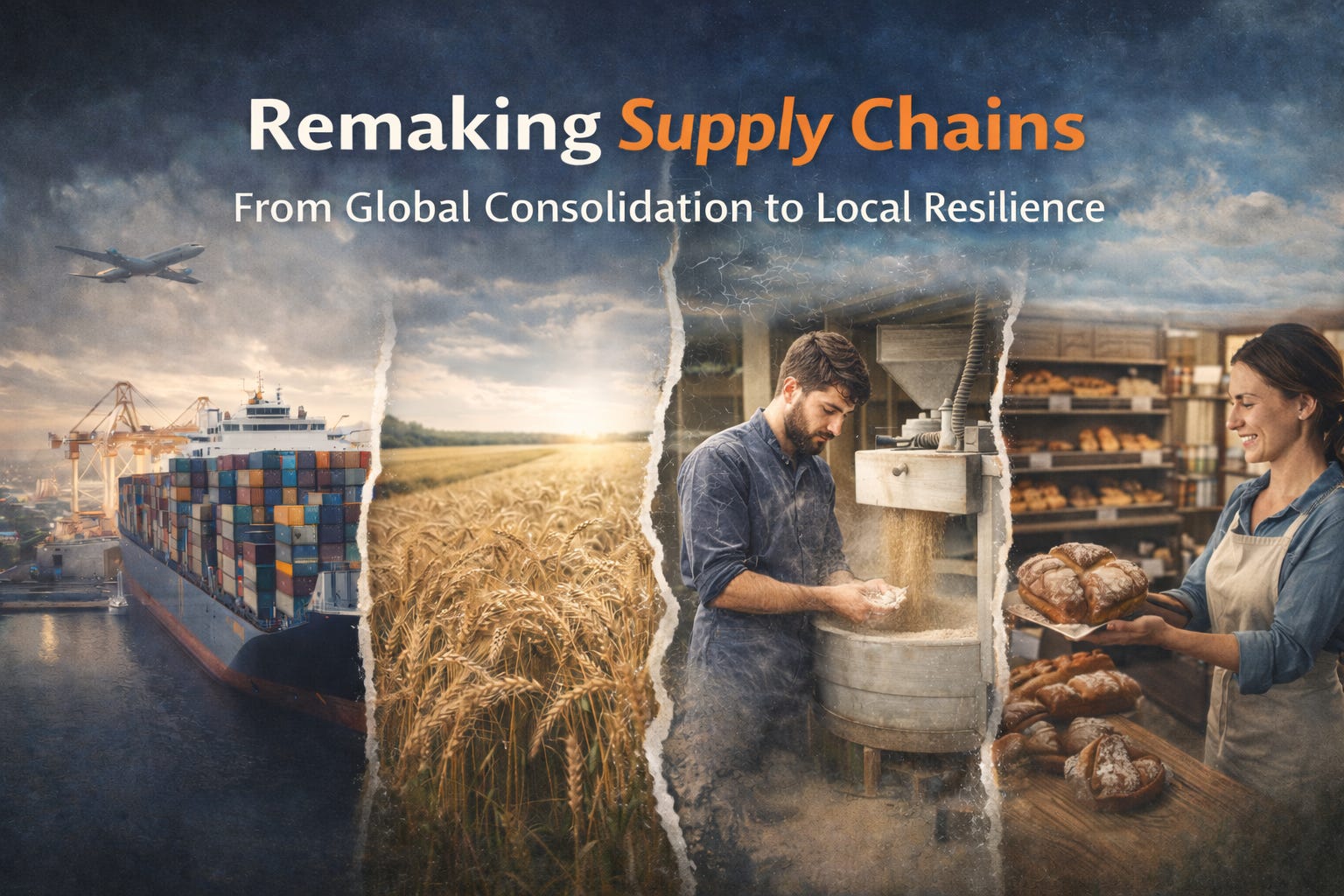
It’s forcing them to be remade.
The End of the Assumption
Global supply chains have, by and large, been built on a set of assumptions:
Trade would continue to liberalize
Shipping lanes would remain secure
Labor would remain globally accessible
Energy would remain affordable
Political systems would remain stable enough
To write that these assumptions are now under strain is an understatement. Trade wars. War wars. Strait of Hormuz. Oil prices over $100.
Geo-political analyst Peter Zeihan and others have pointed to the weakening of the global trade framework that emerged after World War II. Whether or not one agrees with every aspect of that analysis, it is hard to ignore the trend: The system is becoming less predictable.
Less coordinated.
Less global.

Efficiency Was the Goal
For decades, supply chains optimized for efficiency.
That meant concentration of production, just-in-time inventory, single-source suppliers, and global arbitrage of labor and materials.
The result was remarkable.
Products became cheaper. Availability increased. Entire industries scaled.
But efficiency came with a tradeoff.
Fragility.
When systems are optimized for cost, they often lose redundancy. When they are optimized for scale, they often lose flexibility.
And when disruption comes, the system has fewer ways to adapt.
A Personal View: Building BitCorn Nodes
We are experiencing this directly at BitCorn.
What I had thought would be a relatively straightforward process—sourcing electronic components for Bitcorn Nodes—custom built computers—has become unexpectedly complex.
Parts that were once readily available now come with long lead times. Prices fluctuate unpredictably. Availability depends on forces far removed from agriculture or even software. The node that I first built for myself in early 2025 cost $425. Today it costs $725.
The datacenter buildout—driven by AI, cloud expansion, and global compute demand—is pulling enormous volumes of components into a few concentrated channels.
At the same time, material constraints ripple through the system.
The result isn’t just higher cost. It’s uncertainty.
And uncertainty forces a different kind of decision-making.
You begin to think less about optimizing a known system—and more about building a system that can adapt.
From Optimization to Resilience
This is the core shift.
Supply chains are moving from: Optimization → Resilience
From lowest cost, highest efficiency, and tight integration.
To redundancy, flexibility, and modularity.
This doesn’t mean efficiency disappears.
It means it is no longer the only objective.
Rebuilding in Agriculture: Flour
The most important supply chains in the world are agricultural. Yeah, I’m biased. But people need to eat. And there are interesting places to see the beginning of shifts in agricultural supply chains.
Brady Sidwell, an agricultural entrepreneur from Oklahoma, is an example. In a recent interview for my Entrepreneur’s Ethic Podcast, Brady shared that the fastest growing part of his agricultural conglomerate is Chisolm Trail Milling.
For decades, flour supply chains followed the same logic as other industries with centralized milling, commodity inputs, scale-driven processing, and distribution through large channels.
The system worked.
But it also stripped out something along the way: Connection.
Between producer and product. Between grain quality and end use. Between region and consumption.
What Brady is building is not simply a milling business.
It is an attempt to reconstruct a supply chain. One that is regionally grounded, quality differentiated, and closer to both producer and customer.
Instead of relying entirely on a global commodity system, it introduces a layer of intentional structure.
That is not a step backward.
It is a different design.
The company’s growth is fueled by the growth in in small bakeries, neighborhood mercantile stores, and restaurants focused on farm-to-table and fresh ingredients, particularly specializing in sourdough bread. Brady noted that the business emphasizes quality and natural processing over long shelf life, reflecting a broader national trend toward healthier, less processed foods.

Rebuilding in Agriculture: Pork
A similar dynamic is playing out in protein.
Northwest Iowa agricultural entrepreneur Dwight Mogler’s Iowa Craft Meats is working to build a supply chain around high-quality pork products.
Again, the traditional system is well known with large-scale production, large-scale processing, commodity pricing, and national to international distribution
It’s efficient.
But it also compresses differentiation.
Dwight and his team at Iowa Craft Meats is rethinking the system product quality as a primary driver, craftmanship expressed at each level, brand identity tied to production, and a supply chain built around specific outcomes, not just throughput.
This requires rebuilding relationships across the chain, from hog producer, to processors, to distributor, and ultimately to customer.
It is more complex.
But it also creates more value. Have you ever had a pork brisket? How about a pork delmonico steak? How about dry-aged pork rack? I have…

The Pattern
These aren’t isolated examples. They reflect a broader pattern.
When systems become too optimized for one dimension—often cost—they often become brittle.
When conditions change, rebuilding begins.
And rebuilding does not mean replicating the old system.
It means designing something new.
Technology as an Enabler
Technology is not just a disruptor here. It is an enabler.
The same forces that drove aggregation are now enabling disaggregation:
Better information flows
Direct-to-consumer channels
Smaller-scale production technologies
More flexible logistics
These tools allow smaller systems to operate effectively.
They allow supply chains to be reconfigured, not just scaled.
Consumer Demand Is Shifting
At the same time, consumers are changing.
There’s growing demand for traceability, quality differentiation, regional identity, and direct relationships with producers.
These preferences do not align well with fully aggregated systems.
They reward supply chains that can deliver specificity, not just volume.
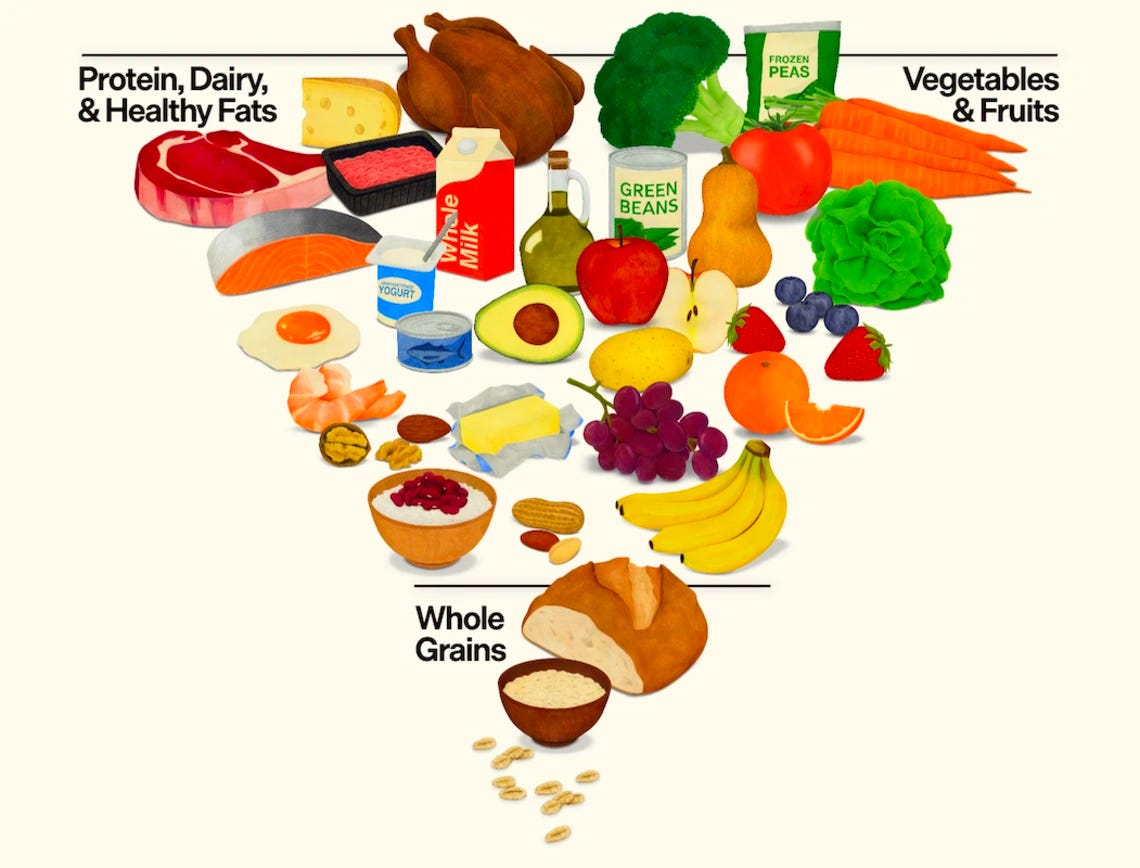
That new food pyramid put out by the U.S. Department of Agriculture? Many say its development is related to the strength of the MAHA (Make America Healthy Again) movement.
No matter its source, look at that steak at the top!
The Emerging Model
Put these pieces together and a new model begins to emerge.
Supply chains are becoming more regional, more modular, more redundant, and more differentiated.
Not everywhere.
Not all at once.
But in enough places to matter.
A System in Transition
Global supply chains won’t disappear.
Large-scale production and distribution will remain essential. People will always economize in their buying decisions.
But the system is no longer singular.
It is becoming layered.
Alongside global systems, we are seeing the emergence of regional systems, specialized systems, and direct-to-consumer systems.
These aren’t replacements.
They’re complements.
Builders of the New Supply Chains
What ties all of this together are builders. The Brady Sidwells and Dwight Moglers of the world.
A point I make in my entrepreneurship courses is that the easiest way to predict the future is to create it.
Builders aren’t waiting for the system to stabilize.
They’re designing new ones.
They’re sourcing differently, producing differently, distributing differently, and pricing differently.
They are, in effect, writing new supply chain code.
For a long time, supply chains were invisible.
They worked so well we didn’t need to see them.
Now, they are becoming visible again.
Not because they are failing.
But because they are being rebuilt. By builders.
The next phase of the economy won’t be defined only by new products or new technologies.
It’ll be defined by new systems for moving, transforming, and delivering value.
Supply chains are no longer just being optimized.
They’re being remade.
I’m thrilled to be a part of the Iowa Startup Collective, a group of writers exploring entrepreneurship. Please check out the Roundup of columns.