Builder Habits
The way you build one thing is the way you build everything.

Fertilizer isn’t usually considered inspirational.
No one hangs posters of nitrogen application maps in dorm rooms. Entrepreneurs rarely give keynote speeches about phosphorus. Venture capital firms are not exactly packed with people saying, “Tell me more about micronutrients.”
And yet over the past several weeks, fertilizer has appeared repeatedly in my conversations.
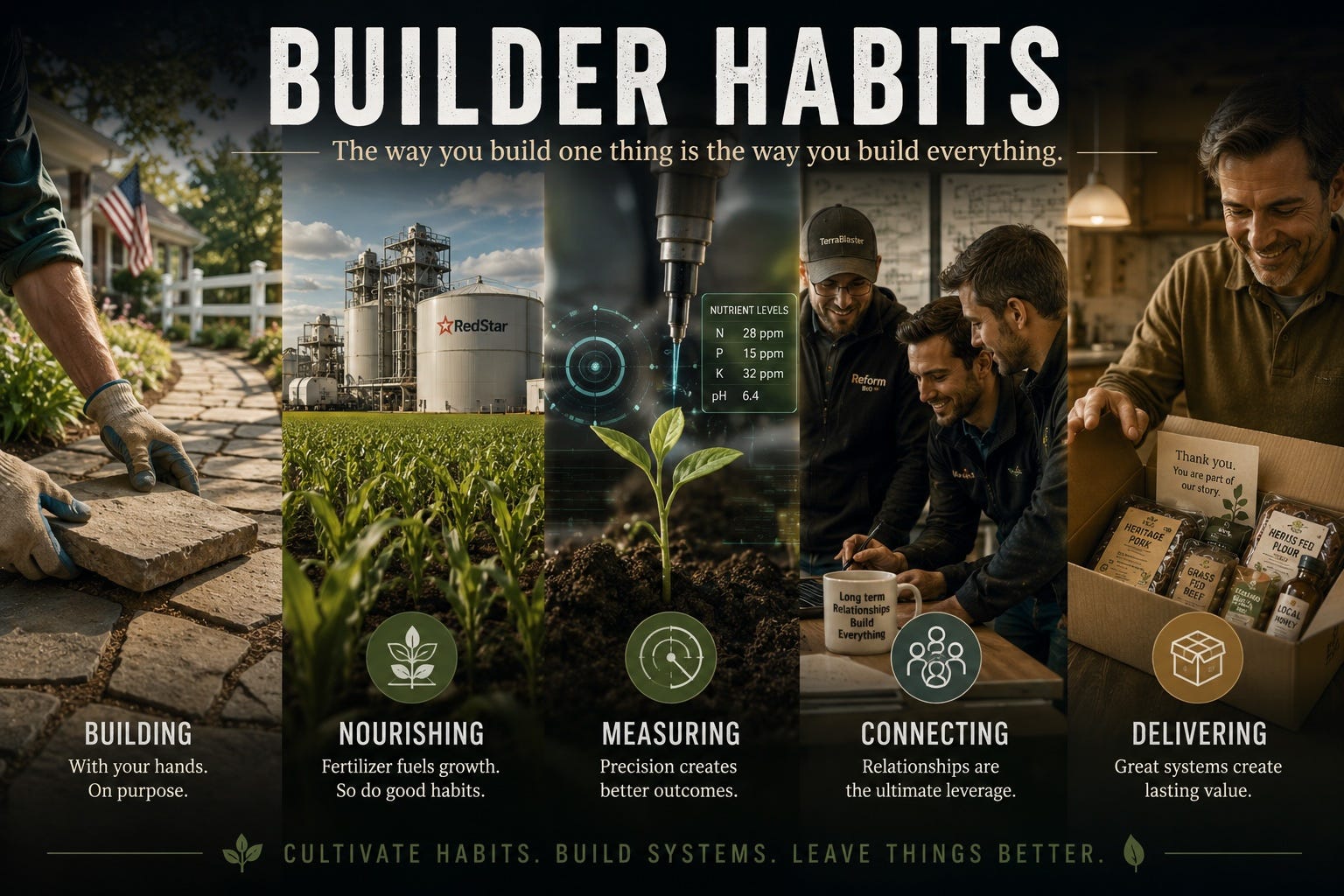
At RedStar in Leigh, Nebraska, founder Ryan Mullenhoff walked me through a liquid fertilizer manufacturing facility. At lunch with Jorge Heraud, co-founder of TerraBlaster, we discussed the future of real-time soil nutrient sensing and precision application. At an Ag Startup Engine investor meeting, Kyle Anderson pitched Reform Bio’s slow-release fertilizer technology. And in a meeting with Chris Boshart, General Manager of Gold Eagle Cooperative, we discussed nitrates, and the increasingly complex relationship between agriculture and water systems.
And fertilizer’s been in the news. The Middle East war is seriously threatening global supply chains important to fertilizer products. Anhydrous ammonia prices in the U.S. have jumped 20 percent. International urea prices have jumped in some places more than 80 percent.
But leaving current events aside, eventually I realized the common thread wasn’t fertilizer.
It was builder habits.
And fertilizer, while not glamorous, is certainly important. U.S. farmers spend tens of billions of dollars annually on fertilizer inputs. For crops like corn and wheat, fertilizer can represent roughly one-third or more of operating costs according to USDA data. In some years, fertilizer becomes one of the single largest cash expenses on the farm—larger than machinery payments, seed, or many other annual operating inputs.
Agriculturalists understand something fundamental: Healthy systems require nourishment.
And the same is true for entrepreneurial builders.
The Phrase I Use With Students
I often tell students in the entrepreneurship courses I teach: The way you do one thing is the way you do everything.
That phrase isn’t about perfectionism. It’s about orientation.
If you aspire to build businesses, organizations, or systems, you can’t limit builder behavior to the hours between 8 a.m. and 5 p.m. Builder habits are not something you turn on selectively. They become part of how you engage with the world.
Builders cultivate. They maintain. They experiment.
They improve systems incrementally over long periods of time.
And importantly, they do these things even when no one is watching.
Flagstone, Fences, and Wednesday Dinners
On our acreage, I take the lead on many of the yard and garden projects.
I built the flagstone sidewalk in front of the house. I put up the white three-rail fence. I built the raised flagstone garden beds. I tend the vining roses.
I don’t do these things because I possess extraordinary landscaping talent. A professional landscaper would complete them faster and better. And I’m never ahead of the home and yard improvement projects on our list.
I do them because they reinforce builder habits.
The same thing happens in the kitchen.
I cook dinner most Wednesday nights. Not because I’m a better cook than Patti—definitely not—but because cooking forces experimentation. Attention. Adjustment. Improvisation.
You learn timing. Process. Recovery from mistakes. Or at least learning from mistakes.
You learn that systems matter.
And over time, you begin to understand that builder habits are less about productivity than cultivation.
Fertility and Entrepreneurship
The more I thought about fertilizer, the more the metaphor expanded.
Healthy soil systems do not happen accidentally. Neither do healthy entrepreneurial systems. Both require nourishment, maintenance, stewardship, balance, and long-term thinking
Too few nutrients and systems weaken.
Too many nutrients and systems become unstable—or destructive.
Precision matters.
That is part of what makes the current wave of agricultural technology so interesting.
TerraBlaster is pursuing real-time nutrient sensing because broad, generalized application increasingly looks inefficient compared to precise application. Reform Bio’s slow-release systems attempt to better synchronize nutrient availability with plant uptake. RedStar continues refining how nutrients are manufactured and delivered at scale.
All of these efforts point toward a broader shift: The future belongs less to blunt force systems and more to adaptive ones.
Builder Habits Are Relationship Habits
The more time I spend around entrepreneurial builders, the more convinced I become that the most important builder habit is not technical.
It’s relationship cultivation.
Ryan Mullenhoff isn’t simply building fertilizer systems. He’s building trust networks with customers, suppliers, and employees.
Jorge Heraud isn’t simply building sensing technology. He’s building connections between agriculture, engineering, data science, precision agriculture technologies, and farmer decision-making.
Kyle Anderson isn’t simply developing fertilizer chemistry. He is building credibility around a new approach.
Chris Boshart isn’t simply managing a cooperative. He is navigating increasingly complex relationships between farmers, regulators, environmental systems, and communities.
The best builders understand that systems are ultimately social.
Even highly technical businesses rise or fall on relationships.
Builders Maintain Things
One of the defining characteristics of builders is that they maintain things.
This sounds simple, but it is increasingly rare.
Modern culture celebrates disruption, novelty, and rapid scaling
But builders understand that systems degrade without maintenance. Gardens become overgrown. Sidewalks crack. Relationships weaken. Businesses drift.
So builders prune, repair, refine, and iterate.
Quietly. Repeatedly. Often invisibly.
The interesting thing about maintenance is that its benefits compound slowly—but so do the costs of neglect.
Agriculture understands this intuitively.
So do good entrepreneurs.
Precision Versus Blanket Application
Agriculture may again be previewing a larger economic shift.
For decades, industrial logic favored broad application: Large-scale systems, standardized treatment, and generalized management.
Now precision is becoming possible. Sensors. Data. Biological feedback systems.
The future increasingly looks like targeted intervention, adaptive systems, and highly specific responses.
Entrepreneurship is evolving similarly.
The old industrial economy often rewarded mass approaches with mass products, mass media, and mass markets.
The emerging economy increasingly rewards specificity.
Builders who understand small details often outperform organizations managing broad abstractions.
Builder Habits Compound
One of the reasons builder habits matter is that they compound long before visible results appear. This is true in soil health, business, relationships, craftsmanship, and physical spaces.
The visible outcome often arrives years after the underlying habits were established.
People sometimes look at successful businesses and assume the key moment was funding, timing, technology, and luck.
Often the more important story is quieter. Years of disciplined curiosity, system maintenance, relationship building, experimentation, and accumulated trust.
Healthy systems rarely emerge suddenly.
They are cultivated.
The Quiet Builders
The best builders are often not the loudest.
They are usually the people improving systems quietly, solving practical problems, developing trust in relationships, refining processes, and developing judgment.
That work compounds.
And eventually entire organizations begin reflecting the habits of the people who built them.
The way a founder handles a garden bed often resembles how they handle a company.
The way they approach cooking resembles how they approach experimentation.
The way they maintain relationships resembles how they build organizations.
The way you build one thing is often the way you build everything.
I’m thrilled to be a part of the Iowa Startup Collective, a group of writers exploring entrepreneurship. Please check out the Roundup of columns.